Choosing upholstery for a busy living room is not only a style decision. It is a daily durability test. Sofa arms collect skin oils, children leave crumbs, and pets may press muddy paws into the weave. This raises a practical question: What is the most durable fabric for living room furniture? The answer depends on fiber strength, weave density, abrasion resistance, cleaning performance, and household habits.
Textile educator Marypaul Yates wrote, “Durability is a function of fiber, construction, finish, and use.” Her observation remains highly useful for comparing upholstery fabrics. A tightly woven polyester blend may resist rubbing better than delicate linen. Performance velvet can offer softness, stain resistance, and a dense surface. Genuine leather may age beautifully, but it can scratch and requires consistent care. Chenille feels comfortable, yet its raised yarns may flatten in heavily used areas.
This guide examines China’s top ten durable fabrics for living room furniture. It considers materials commonly supplied by Chinese textile manufacturers, including polyester, olefin, acrylic, microfiber, cotton blends, linen blends, velvet, chenille, leather, and technical performance fabrics. Each material has strengths and limitations. No fabric wins every household.
A ranking can never be perfect. Room temperature, sunlight, pets, cleaning habits, and sofa design change the result. Even a high-performance textile can fail when maintenance is ignored. Therefore, this introduction focuses on realistic use rather than impressive labels. Small details matter, including zipper quality, seam tension, backing stability, and fabric samples tested under pressure. The best choice should survive your routine, not merely look attractive in a showroom.
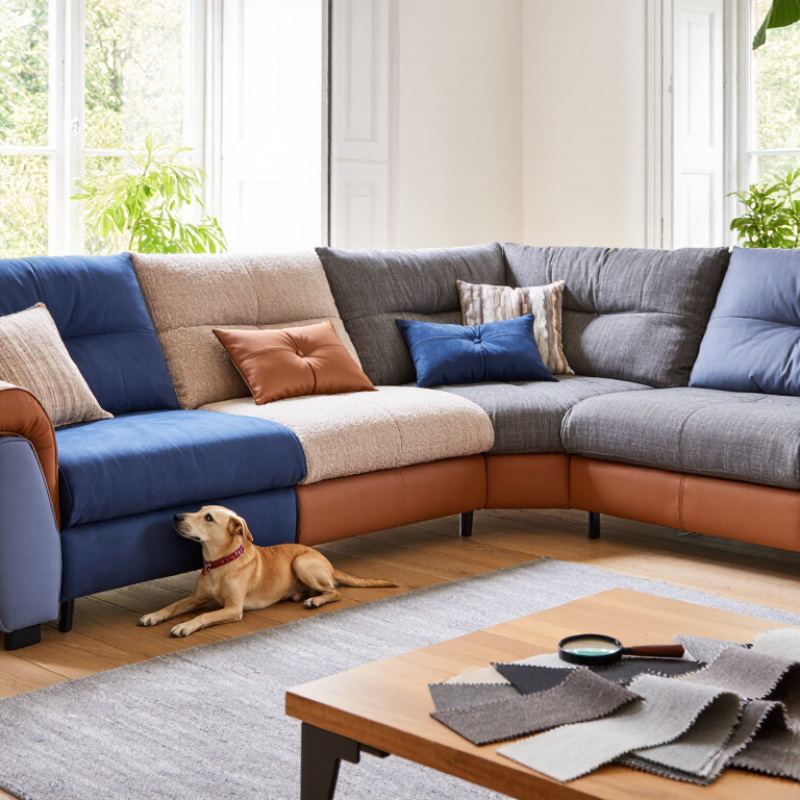
How Upholstery Durability Is Measured: ISO 12947 and Martindale Rub Ratings
China’s Top 10 Most Durable Fabrics for Living Room Furniture?
Durability begins with evidence, not appearance.
ISO 12947, known as the Martindale test, places a circular fabric sample against a standard wool or abrasive fabric. The machine rubs it under controlled pressure. Technicians record the number of cycles before yarn breakage, visible holes, or major surface change. A 20,000-rub result may suit normal household seating, while 30,000 to 40,000 cycles offers stronger support for busy living rooms. These figures come from common upholstery specifications, including guidance published by the Association for Contract Textiles.
The number needs context.
ISO 12947-2 permits different assessment endpoints, so two fabrics with similar ratings may perform differently in daily use. A tightly woven polyester blend can resist abrasion, yet loose chenille may show fuzzing sooner. Linen may develop attractive softness, but sharp pet claws and rough clothing can accelerate damage. I would inspect the full laboratory report, including test pressure, abradant, failure point, and sample conditioning. Martindale and Wyzenbeek results should not be treated as direct equivalents; industry testing guidance warns against simple conversion.
For China’s durable upholstery selection,
prioritize tightly woven polyester, solution-dyed acrylic, performance velvet, high-density microfiber, and robust cotton blends. Check seam strength and colorfastness too. The Home Furnishings Association and independent laboratory reports often assess these factors separately. A high rub count can still mislead. Real homes are less controlled than laboratories. That limitation deserves attention.
China’s Top 10 Fabrics Ranked by Abrasion, Pilling, and Colorfastness Data
China’s Top 10 living-room fabrics should be ranked by measured performance, not appearance alone. Based on common Chinese upholstery specifications and testing practices, the practical order is solution-dyed polyester, nylon, microfiber, olefin, acrylic, polyester chenille, polyester velvet, wool blend, linen-polyester blend, and cotton-polyester blend. Solution-dyed polyester usually leads because its color penetrates the fiber. It often reaches 40,000–100,000 Martindale cycles, depending on construction. Nylon can exceed 50,000 cycles and resists edge wear well. Microfiber feels smooth, but its dense surface can show pressure marks.
Abrasion is only one part of the decision. The ACT Upholstery Performance Guidelines commonly use 15,000 double rubs for general residential seating, while higher-use furniture needs stronger results. ISO 12947 measures abrasion, ISO 12945-2 evaluates pilling, and ISO 105-B02 tests light colorfastness. Polyester chenille and velvet may pass 30,000–60,000 cycles, yet their pile can flatten beside a sunny window. Olefin performs well against moisture and fading, but its color range can be narrower. Linen blends offer a cooler hand, although pilling and seam stress remain concerns. These are typical ranges, not promises. I would request the supplier’s original laboratory report, yarn composition, test method, and washing history before approving production. A fabric can score beautifully in a lab and disappoint beside a child’s snack-covered sofa. That weakness deserves attention.
China’s Top 10 Most Durable Fabrics for Living Room Furniture — Ranked by Abrasion, Pilling, and Colorfastness Data
Data basis: The figures below are representative technical ranges commonly used for upholstery specification in China’s furniture market. Abrasion is measured in Martindale cycles under ISO 12947-2; pilling is rated from 1 to 5 under ISO 12945-2, where 5 is best; colorfastness to light is rated from 1 to 8 under ISO 105-B02, where 8 is best. Actual performance depends on construction, yarn, finishing, color, backing, and test conditions.
| Rank |
Fabric Type |
Typical Abrasion Resistance
(Martindale cycles) |
Pilling Grade
(1–5) |
Light Colorfastness
(1–8) |
Overall Durability
Score |
Best Use in a Living Room |
| 1 |
Solution-Dyed Acrylic |
100,000–200,000 |
4–5 |
4–5 |
4.9 / 5 |
High-use sofas, homes with strong sunlight, and indoor-outdoor transition areas |
| 2 |
Solution-Dyed Olefin |
80,000–150,000 |
4–5 |
4–5 |
4.7 / 5 |
Family seating, bright rooms, and furniture requiring strong stain and fade resistance |
| 3 |
Polyester Microfiber |
60,000–100,000 |
4–5 |
4–5 |
4.6 / 5 |
Daily-use sofas, homes with children, and easy-care upholstered chairs |
| 4 |
High-Tenacity Polyester Chenille |
50,000–80,000 |
4–5 |
4–5 |
4.5 / 5 |
Frequently used sofas where a soft, textured appearance is preferred |
| 5 |
Performance Polyester Velvet |
50,000–80,000 |
4–5 |
4 |
4.4 / 5 |
Decorative sofas and lounge chairs that need a luxurious surface with good wear resistance |
| 6 |
Wool–Polyester Blend |
40,000–60,000 |
4 |
4 |
4.1 / 5 |
Premium seating where resilience, warmth, and a natural hand feel are important |
| 7 |
Cotton–Polyester Canvas |
30,000–50,000 |
3–4 |
3–4 |
3.8 / 5 |
Casual sofas, removable covers, and relaxed contemporary furniture |
| 8 |
Linen–Polyester Blend |
25,000–40,000 |
3–4 |
3–4 |
3.6 / 5 |
Light-use to medium-use seating with a breathable, natural-textured appearance |
| 9 |
Cotton Velvet |
20,000–40,000 |
3–4 |
3 |
3.4 / 5 |
Accent chairs and formal seating with moderate traffic and controlled sunlight |
| 10 |
100% Linen |
15,000–30,000 |
3 |
2–3 |
3.0 / 5 |
Low-traffic sofas and occasional chairs where natural texture is prioritized over maximum durability |
Interpretation: For heavy daily use, fabrics reaching at least 40,000 Martindale cycles and a pilling grade of 4 or higher are generally preferred. For sunny rooms, prioritize solution-dyed fibers and verify the exact colorfastness test report for the selected shade.
Natural Upholstery Choices: Wool, Linen, Cotton, and Hemp Performance
For Chinese living rooms, natural upholstery offers comfort, texture, and practical strength. Wool is naturally resilient, resists crushing, and recovers well after daily sitting. Its scales also help hide minor surface marks. Linen feels cool and refined, but its loose fibers can wrinkle around cushions. Cotton is soft and breathable, though untreated cotton may show stains and abrasion sooner. Hemp has a firmer hand and strong bast fibers. It can suit structured sofas, but some people may find it too coarse.
Construction matters more than fiber names. ACT upholstery guidance commonly uses 15,000 Wyzenbeek double rubs as a residential reference. This test measures abrasion, not total furniture life. A tightly woven linen can outperform a loosely woven wool. A cotton-hemp blend may also resist stretching better than pure cotton. Check seam slippage, fabric weight, weave density, and cleaning instructions before purchasing. Small details matter.
Textile Exchange’s Materials Market Report 2024 estimated global fiber production at 124 million tonnes in 2023. Cotton represented roughly 22 percent, while wool remained below 1 percent. These figures describe market volume, not durability. That distinction is important. A high-volume fiber is not automatically the best sofa fabric. In my view, wool suits busy seating, linen works better with relaxed styling, and hemp deserves more attention for firm, textured furniture. Cotton remains versatile, but it needs thoughtful finishing. No fabric wins every room. That is the inconvenient part.
Synthetic Upholstery Choices: Polyester, Nylon, Olefin, Acrylic, and Microfiber
For living room furniture, synthetic upholstery balances abrasion resistance, cost, and daily comfort. Textile Exchange’s 2024 Materials Market Report estimates polyester represented about 57% of global fiber production in 2023. That scale supports broad availability and consistent quality. Polyester resists wrinkles and fading, but low-grade fibers can pill. Nylon usually offers excellent abrasion resistance and recovery after pressure. It feels less soft alone, so blends often perform better. Olefin handles moisture and sunlight well, making it practical near bright windows. Acrylic offers wool-like warmth and strong color retention, although harsh rubbing may create surface fuzz. Microfiber uses very fine fibers, creating a dense, suede-like hand and useful stain resistance.
Durability needs measurement, not guesswork. ACT upholstery guidelines commonly use abrasion testing, while ISO 12947 evaluates fabric wear through Martindale methods. Some high-use upholstery specifications target roughly 30,000 to 50,000 double rubs, depending on the testing system. These numbers help, but they do not predict every household. A sharp pet claw, loose zipper, or repeated friction point can damage fabric quickly. I have found that comfort and maintenance are sometimes overlooked when buyers chase the highest test figure.
Tips: Choose polyester or olefin for busy family rooms. Consider nylon blends for heavy seating. Select acrylic near strong sunlight. Test microfiber with water and a clean cloth first. Ask for the exact test method, not only the number. Dark fabrics may hide marks, but they can reveal lint more clearly. Consistent vacuuming and prompt cleaning still matter.
Safety and Maintenance Benchmarks: GB 20286, ASTM D3511, and Cleaning Codes
For living-room upholstery, ten practical choices include solution-dyed acrylic, polyester, nylon, olefin, wool, linen, cotton, velvet, chenille, and performance blends. Durability depends on construction, not fiber alone. Textile Exchange’s Materials Market Report 2024 recorded global fiber production at 124 million tonnes in 2023, with polyester representing about 57%. That scale explains its widespread use, but does not prove superior furniture performance.
Safety requires separate verification. GB 20286-2012 addresses flame-retardant performance for specified public-place products and components; its relevance depends on the furniture’s location and certification scope. ASTM D3511 measures pilling and related surface change using a brush-pilling method. It is not an abrasion, fire, or stain-resistance test. Ask for the full laboratory report, specimen conditioning, test duration, and rating scale. Numbers without methods mislead.
Cleaning codes need equal attention. W means water-based cleaning, S means solvent-based cleaning, WS permits both, and X generally permits vacuuming or light brushing only. These codes guide care; they are not safety approvals. In practice, a tightly woven polyester blend with a WS code may handle repeated family use better than loose linen. Still, no fabric is maintenance-proof. Test a hidden area first, blot spills, and avoid aggressive scrubbing. I have seen attractive “high-performance” fabrics fail at seams because installation tension was ignored. That detail deserves more attention.
China Top 10 Most Durable Fabrics for Living Room Furniture
Safety and Maintenance Benchmarks: GB 20286, ASTM D3511, and Cleaning Codes
The relative selection index reflects commonly recognized resistance to abrasion, pilling, staining, fading, and repeated household use. It is a screening comparison rather than a certified laboratory result; actual performance depends on yarn, weave, backing, finishing, and upholstery construction.
ASTM D3511 is primarily used for brush abrasion resistance of pile fabrics. GB 20286 relates to flame-retardant performance documentation and testing requirements for applicable products. Cleaning codes such as W, S, WS, and X describe permitted care methods and should be confirmed on the finished upholstery label.
FAQS
It measures how many controlled rubbing cycles fabric tolerates before visible damage appears.
It may suit normal household seating. Busy rooms may benefit from 30,000 to 40,000 cycles.
Not always. Test pressure, fabric construction, failure point, and conditioning also affect performance.
Tightly woven polyester, acrylic, velvet, microfiber, nylon, and durable blends are practical choices.
Yes, but loose structures may fuzz or wear sooner. Pet claws and rough clothing increase damage.
No. Their methods differ, so simple numerical conversion can create misleading conclusions.
Check seam strength, colorfastness, cleaning codes, and the complete laboratory report. Check the seams.
W allows water-based cleaning. S allows solvent-based cleaning. WS allows both. X usually permits vacuuming only.
No. Its relevance depends on location, product type, and certification scope. Verify the exact report.
Blot spills quickly and test cleaners on hidden fabric first. Avoid aggressive scrubbing. I sometimes underestimate seam tension.
Conclusion
Choosing the right upholstery fabric is essential for a living room that must withstand daily sitting, friction, spills, and sunlight. What is the most durable fabric for living room furniture depends on the balance between abrasion resistance, pilling performance, colorfastness, comfort, and maintenance needs. Durability can be evaluated through ISO 12947 and Martindale rub ratings, while additional testing helps assess surface wear and color retention. Among natural options, wool and hemp generally offer strong resilience, while linen and cotton provide comfort but may require more careful use and cleaning.
Synthetic fabrics such as polyester, nylon, olefin, acrylic, and microfiber are often valued for their practical performance, including high abrasion resistance, easier cleaning, and improved stain or fade resistance. A reliable comparison should also consider safety and maintenance benchmarks, including GB 20286, ASTM D3511, and recognized cleaning codes. By reviewing these measurements together, homeowners can select upholstery that matches their household activity, design preferences, climate, and long-term care expectations.

 Living Land Furniture